
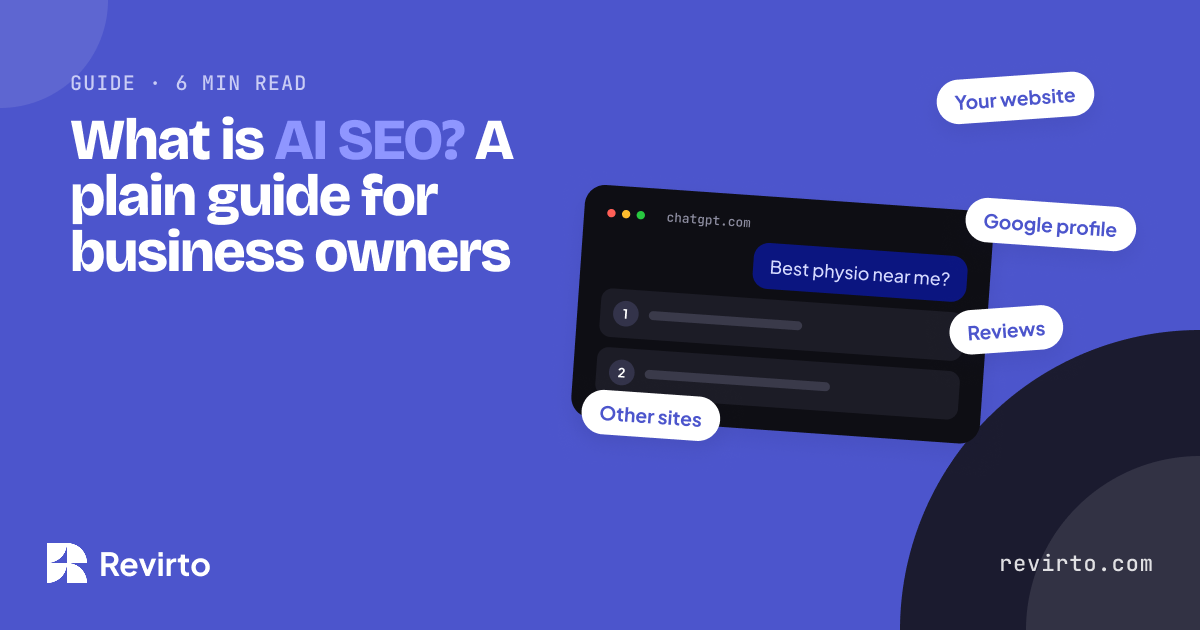
AI SEO means making your business easy for AI tools like ChatGPT, Gemini and Perplexity to understand and trust, so they name you when a customer asks for a recommendation. It builds on normal SEO: a clear website, answers to real questions, good reviews and mentions on other sites. The difference is the goal. Instead of ranking in a list of ten links, you want to be one of the two or three names in the answer.
Why this matters now
For twenty years, finding a business online meant typing a few words into Google and scrolling through a list. That still happens. But more and more people now ask an AI tool the question they’d ask a friend: “Who’s a good family dentist near me?” or “Which accountant in Leeds works with small businesses?”
The AI doesn’t show ten links. It names two or three businesses, explains why, and the person often stops there. If you’re not one of those names, that customer may never see your website at all.
Google is moving the same way. AI Overviews now sit above the normal results for many searches, and they also name businesses and sources directly. If you want the practical steps, read how to get your business recommended by ChatGPT.
What AI tools look at
AI tools build their answer from what they can find and trust about you. In practice, that means five places:
- Your website: what you do, for whom, where, and what it costs
- Your Google Business Profile: services, hours, categories and photos
- Your reviews: how many, how recent, and which services they mention
- Directories and listings: whether your name, address and phone match everywhere
- Other sites: local lists, articles, partners and news that mention you by name
| How strongly each factor goes with being named in ChatGPT | Correlation (0 to 1) |
|---|---|
| Mentions on YouTube | 0.737 |
| Mentions on other websites | 0.664 |
| Links that use your brand name | 0.511 |
| People searching for your brand | 0.352 |
| Domain rating | 0.266 |
| Number of pages on your site | 0.194 |
When those five places agree with each other, the AI can describe you with confidence, and it’s far more likely to recommend you.
SEO vs AI SEO
| Normal SEO | AI SEO | |
|---|---|---|
| Goal | Rank on page one of Google | Be named in the AI’s answer |
| Result | A list of ten links | Two or three names, with reasons |
| What counts | Keywords, links, speed | Clear answers, consistency, mentions |
| How you measure it | Rankings and clicks | How often you’re named for real questions |
They aren’t rivals. A fast, well-built website with good Google rankings is the base AI SEO builds on. The extra work is about clarity: making sure every page answers a real question plainly enough for an AI to repeat it.
The five steps
1Write down the questions your customers ask
Use their words, not yours. “How much is Invisalign in Manchester?” is a question. “Orthodontic solutions” is not. These questions become your scoreboard.
2Give every service its own page
One page per service, with the answer in the first two lines and your town or city on the page. A single “Services” page makes the AI guess.
3Answer the awkward questions
Price or price ranges, how long it takes, what’s included, who it’s for. If your site doesn’t say, the AI names a business whose site does.
4Make your details agree everywhere
Same name, address, phone and services on your website, Google profile and directories. Ask happy customers for reviews that mention the specific service.
5Get mentioned, then check every month
Local lists, partner sites and articles that name you all help. Then ask the AI your questions every month, in a private window, and write down who it names.
Common mistakes
| Mistake | Why it doesn’t help much |
|---|---|
| Stuffing pages with keywords | AI tools read for meaning, not repeated phrases |
| One long Services page | The AI can’t tell what you’re best at |
| Hiding prices completely | People ask about cost first; the AI answers with someone else |
| Buying lots of cheap links | Mentions that matter come from real, relevant sites |
| Checking once and stopping | Answers change month to month, so you need to keep watching |
A real example: Tyde
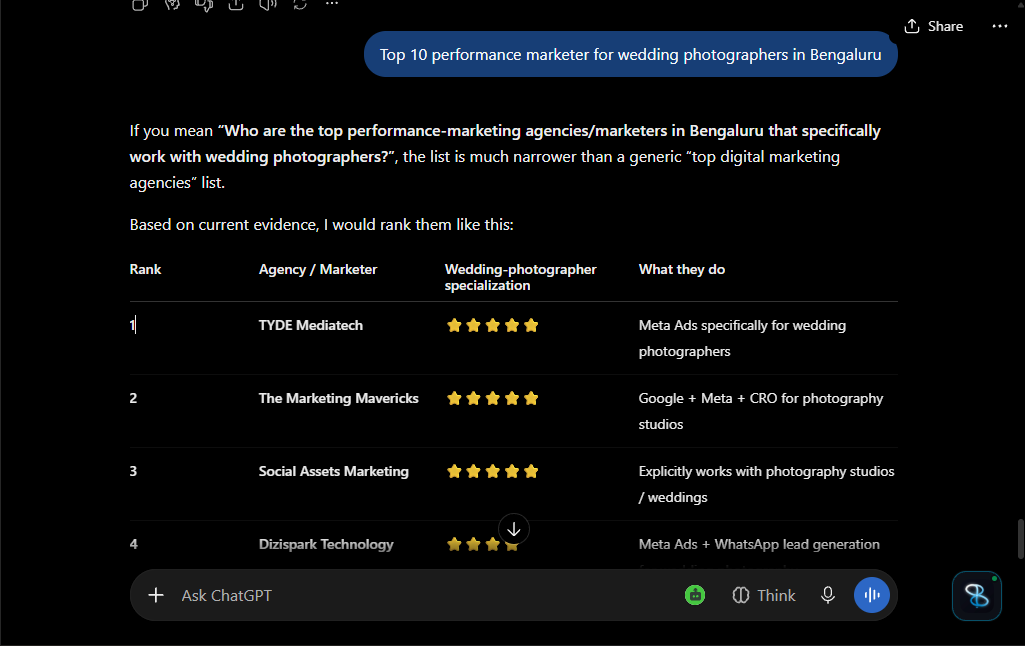
Tyde came to us with a brand-new domain. No history, no reviews, no mentions anywhere. We wrote down the 26 questions its buyers ask, built pages that answer them, got Tyde mentioned on other trusted sites, and checked the same questions in ChatGPT every month.
Tyde was named by ChatGPT in 30 days, for the first time. Six months later it names Tyde first for 18 of the 26 questions, and in the top three for 25. Those answers bring in 10+ qualified calls a month, with no ads.
Being named by AI is a habit, not a one-time fix.
It wasn’t a straight line. When new content slowed down, visibility dipped. When publishing started again, it came back.
Your first 30 days
- Write down 10 questions your customers ask, in their own words
- Ask each one in ChatGPT in a private window and note who it names
- Fix your homepage’s first line: what you do, for whom, and where
- Make sure your Google Business Profile lists every service you offer
If you’d rather have this done for you, see our AI SEO plans.
Common questions
Is AI SEO different from normal SEO?
It builds on it. Normal SEO helps you rank on Google. AI SEO makes sure AI tools understand you well enough to name you. Most of the work, like clear pages and good reviews, helps both.
How long does AI SEO take to work?
It varies by business and competition. For one client on a brand-new domain, ChatGPT started naming them within 30 days. Most businesses should expect a few months of steady work before results are reliable.
Can a small business compete with big brands?
Often, yes. AI tools look for the clearest, most relevant answer, especially for local questions. A small clinic with a page per treatment can be named ahead of a large chain.
Can anyone guarantee I’ll be named by ChatGPT?
No. Nobody controls what AI tools say. Good AI SEO improves your chances and measures progress honestly every month.