
ChatGPT recommends businesses it can read about in more than one place. Make your own pages answer buyer questions clearly. Then get named on other sites: lists, directories, reviews and YouTube. Check the same questions every month.
Why this matters now
A buyer used to type a search and get ten links. Now many of them ask a question and get one answer, with two or three names in it. If you are not one of those names, you are not on page two. You are just not there.
That changes the job. Ranking a page is no longer enough. The tool has to know your business well enough to say its name.
What AI tools look at
AI tools do not see your design. They read the words on your pages, and they read what the rest of the web says about you. When both tell the same story, the tool is more willing to repeat it.
The best evidence so far is a study by Ahrefs of 75,000 brands. It measured which signals go with being named in ChatGPT, Google’s AI Mode and AI Overviews.
| How strongly each factor goes with being named in ChatGPT | Correlation (0 to 1) |
|---|---|
| Mentions on YouTube | 0.737 |
| Mentions on other websites | 0.664 |
| Links that use your brand name | 0.511 |
| People searching for your brand | 0.352 |
| Domain rating | 0.266 |
| Number of pages on your site | 0.194 |
Two things stand out. Being talked about matters more than being linked to. And the size of your own site matters least of all. Publishing more pages on your own domain will not do it alone.
The five steps
1Write down what your buyers ask
Start with real questions, not keywords. “Who is the best family lawyer in Austin?” “How much does a kitchen renovation cost in Manchester?” Ask your last five clients what they typed, or what they asked a friend. Pick 20 questions. That list is your scoreboard for the rest of the year.
2Make each page answer one question
Give every service its own page. Put the question in the heading and the answer in the first two lines. Then add the detail a buyer needs: price ranges, how long it takes, and who it is for. One page, one topic, and the answer first.
3Get named on other sites
This is the part most businesses skip, and the data says it matters most. Get listed on directories that check their entries. Ask clients for reviews on Google. Find the “best of” lists in your trade and your city, and ask the owner to add you. Do not write a list that puts yourself first: AI tools do cite those lists, but they often do not recommend from them.
4Show up on YouTube and LinkedIn
YouTube mentions were the strongest signal in the study. You do not need a studio. A screen recording that answers one buyer question is enough. On LinkedIn, post from your own profile, in your own name. Say what you do and where you do it, the same way each time.
5Check the same questions every month
Open a private window. Log out. Ask the tool each of your 20 questions and write down who it names. Do it again next month. One answer tells you little. The trend tells you whether the work is paying off.
of the page types ChatGPT cites are “best X” lists
Ahrefs, across 14 studies of AI search, 2026Common mistakes
| The tip | What the data says |
|---|---|
| Add an llms.txt file | No clear effect on citations in a study of 300,000 domains. Fine as housekeeping, nothing more. |
| Publish more and more blog posts | The number of pages on a site had the weakest link to AI visibility in the Ahrefs study. |
| Buy backlinks | Backlinks went with AI visibility far less than brand mentions did. |
| Write a “best of” list with yourself at #1 | Often cited, rarely recommended from. |
A real example: Tyde
Tyde is a marketing agency for wedding businesses. It started with a brand-new domain. Within 30 days ChatGPT began naming it for three or four questions, and named it first for one.
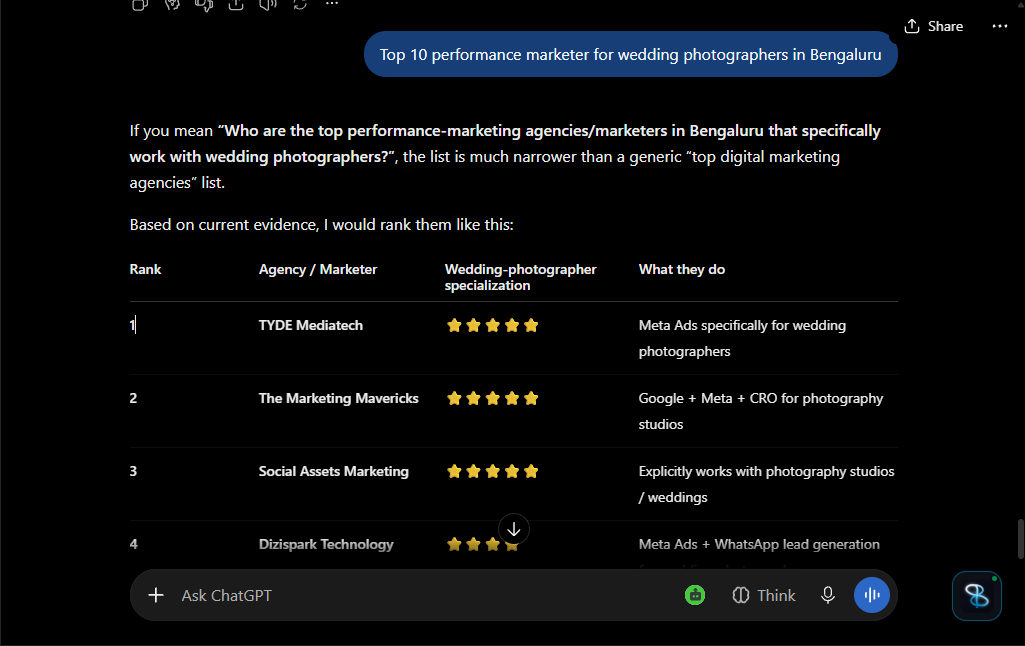
By month six we were tracking 26 questions. Tyde was first for 18 of them and in the top three for 25. Then the content slowed down, and the visibility dropped with it. When the content started again, it began to come back.
Being named by AI is a habit, not a one-time fix.
Your first 30 days
- Week 1Write your 20 questions. Run them once and save the screenshots.
- Week 2Rewrite your three main service pages so the answer comes first.
- Week 3Complete your Google Business Profile and two trusted directories. Ask five clients for a review.
- Week 4Post one helpful answer on LinkedIn or YouTube. Ask two list owners to add you.
Common questions
How long does it take?
It varies. Tyde saw its first mentions within 30 days, on a new domain. A crowded market will take longer. Give it three months before you judge it.
Do I still need normal SEO?
Yes. AI tools read the same pages Google does. A slow or unclear site holds both back.
Can I pay to be recommended?
Not inside the answer itself. Ads in AI tools are labelled as ads. The recommendation comes from what the tool has read about you.
Does this work for a small local business?
Yes, and often faster. Fewer businesses in one city are doing this work, so the gap is easier to close.
- Ahrefs: Top brand visibility factors in ChatGPT, AI Mode and AI Overviews (75k brands), Dec 2025
- Ahrefs: Do self-promotional “best” lists boost ChatGPT visibility? (750 prompts), Dec 2025
- Ahrefs: Self-promotional content works, until it backfires (AI SEO experiment), Jul 2026
- Search Engine Journal: LLMs.txt shows no clear effect on AI citations (300k domains), Nov 2025
- Revirto: Tyde case study (26 questions tracked monthly)