
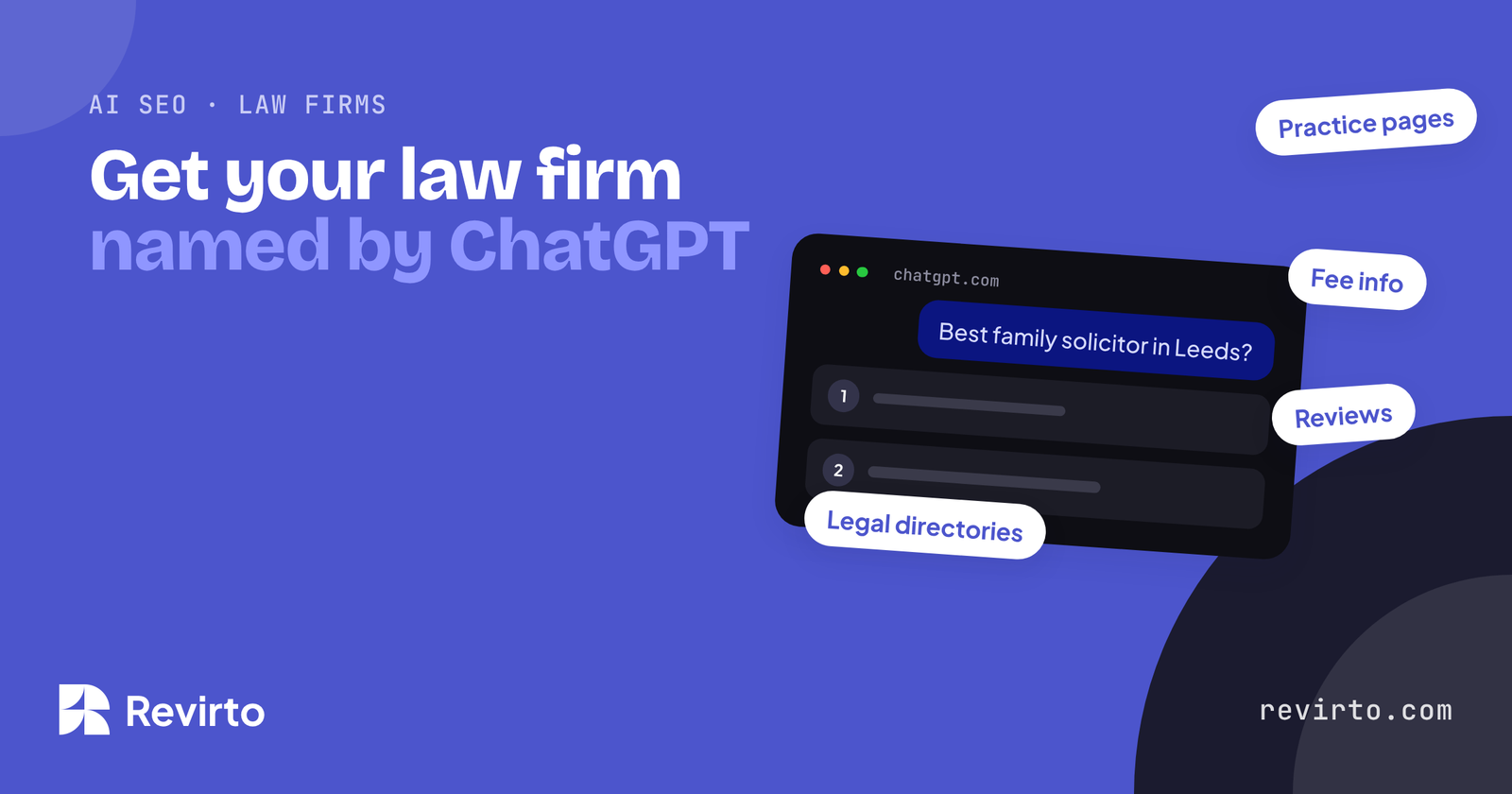
ChatGPT names law firms it can clearly match to a practice area and a place, and that other trusted sites agree about. To be named, a firm needs one page per practice area with the city on it, clear fee information, recent reviews that mention the type of case, and listings in the legal directories AI tools read, like Chambers, The Legal 500, Avvo or the Law Society’s Find a Solicitor.
Do people really ask ChatGPT for a lawyer?
Yes, and the questions are often more detailed than a Google search. Someone going through a divorce doesn’t type “family law”. They type “I’m separating and we own a house together, who’s a good family solicitor in Leeds who does fixed fees?”
That’s exactly the kind of question AI tools are built to answer. The reply names two or three firms with a reason for each. For a buyer who’s stressed and short on time, that shortlist is often the whole search.
This post is about UK and US firms, but the same rules apply anywhere. If you’re new to the idea, start with what AI SEO is.
What questions do clients type?
Legal questions fall into a few clear patterns. Here are typical examples:
| Type | Example question |
|---|---|
| Best in place | Who’s the best family solicitor in Leeds? |
| Specific situation | I’ve been unfairly dismissed in Manchester. Which employment lawyers take no-win-no-fee cases? |
| Price | How much does a conveyancing solicitor cost in Bristol, and who’s good? |
| US practice area | Who’s a good personal injury attorney in Austin for a car accident? |
| Urgent | I need an immigration lawyer in Houston this week. Who should I call? |
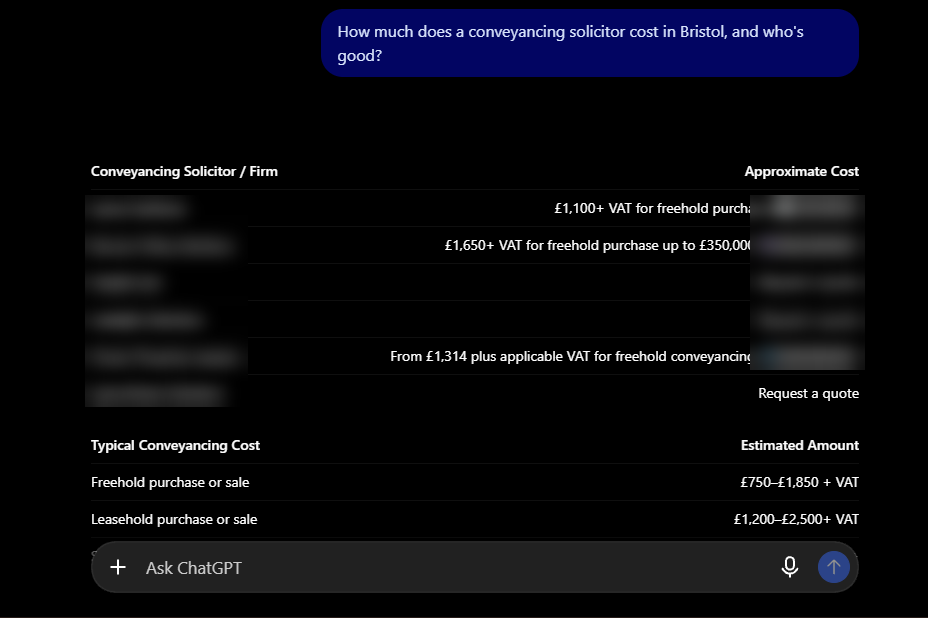
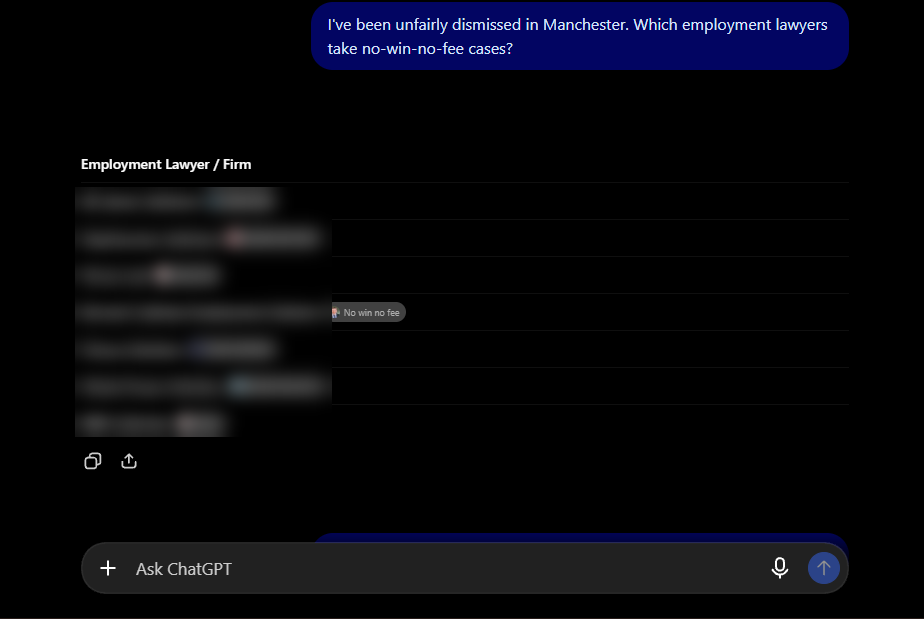
Run your own version of these before you change anything. Here’s how to check whether ChatGPT names your firm properly, without your own history skewing the answer.
What makes AI pick one firm over another?
AI tools can’t judge how good a lawyer is in court. They judge what they can read. In practice that comes down to four things:
1. A clear match between practice area and place
“Family law, Leeds” on a page titled “Family solicitors in Leeds” is easy to match. A single “Our services” page listing eight practice areas makes the tool guess.
2. Legal directories
AI tools lean on sources that check their entries. For law, that means directories: Chambers and Partners and The Legal 500 for ranked firms, the Law Society’s Find a Solicitor and the SRA register in England and Wales, and Avvo, Justia, Martindale-Hubbell and state bar listings in the US.
3. Reviews that mention the case type
“Great firm” helps a little. “Sarah handled our house sale in six weeks and kept us updated” tells the AI which service and which outcome. Reviews on Google, Trustpilot and ReviewSolicitors (UK) or Avvo (US) all get read.
4. Mentions in the press and on other sites
Comment in local news, articles on legal sites and “best firms in [city]” lists all count. Being talked about matters more than links: in a 75,000-brand study, mentions on other websites went with being named in ChatGPT far more than backlinks did.
How strongly mentions on other websites go with being named in ChatGPT. Domain rating: 0.266.
Ahrefs, 75,000 brands, Dec 2025What should a law firm’s website show?
Every practice area page should answer the questions a client asks before they call. Use this as a checklist:
| Section | What to include |
|---|---|
| The answer first | Who you help, with what, and where, in the first two lines |
| Fees | Fixed fees or ranges where you can. Firms in England and Wales already publish price information for services like conveyancing and probate under SRA rules; make it easy to find. |
| The process | What happens, step by step, and how long it usually takes |
| Who handles it | The named lawyers, their experience and their regulator number |
| Proof | Reviews and outcomes that mention this practice area (within your bar’s advertising rules) |
| FAQs | 5–8 real client questions, answered plainly, with FAQ schema |
| Location | Office address, the areas you cover, and a map |
In the US, check your state bar’s advertising rules before using words like “specialist” or “expert”, and before quoting past results.
Where to start this month
You don’t need to do everything at once. In the first month, focus on the pages and listings AI tools read most.
- Write 10 questions clients askin their words, and run them logged out in ChatGPT
- Split any combined “services” pageinto one page per practice area, with the city in the heading
- Add fees or fee rangesand a short “what happens next” section to each page
- Claim and complete your listingsGoogle Business Profile, Law Society or state bar listing, and one review platform
- Ask five recent clients for a reviewthat mentions their type of case
If you’d rather have it done for you, that’s what AI SEO for law firms covers: the question list, the pages, the listings and a monthly check.
Common questions
Is it allowed to market a law firm like this?
Yes. Clear practice-area pages, fee information and directory listings are standard. Follow your regulator’s rules on reviews, past results and terms like “specialist”.
Do Chambers or Legal 500 rankings matter for small firms?
They help if you have them, but they aren’t the only route. Local listings, reviews that name the case type and clear practice-area pages work for small firms too.
How long does it take for a law firm to get named?
Legal markets are usually crowded, so expect three months or more of steady work before judging it.
Should every lawyer have their own page?
Yes. AI tools and clients both look for the person, not just the firm. A page per lawyer with their practice areas and experience helps both.