
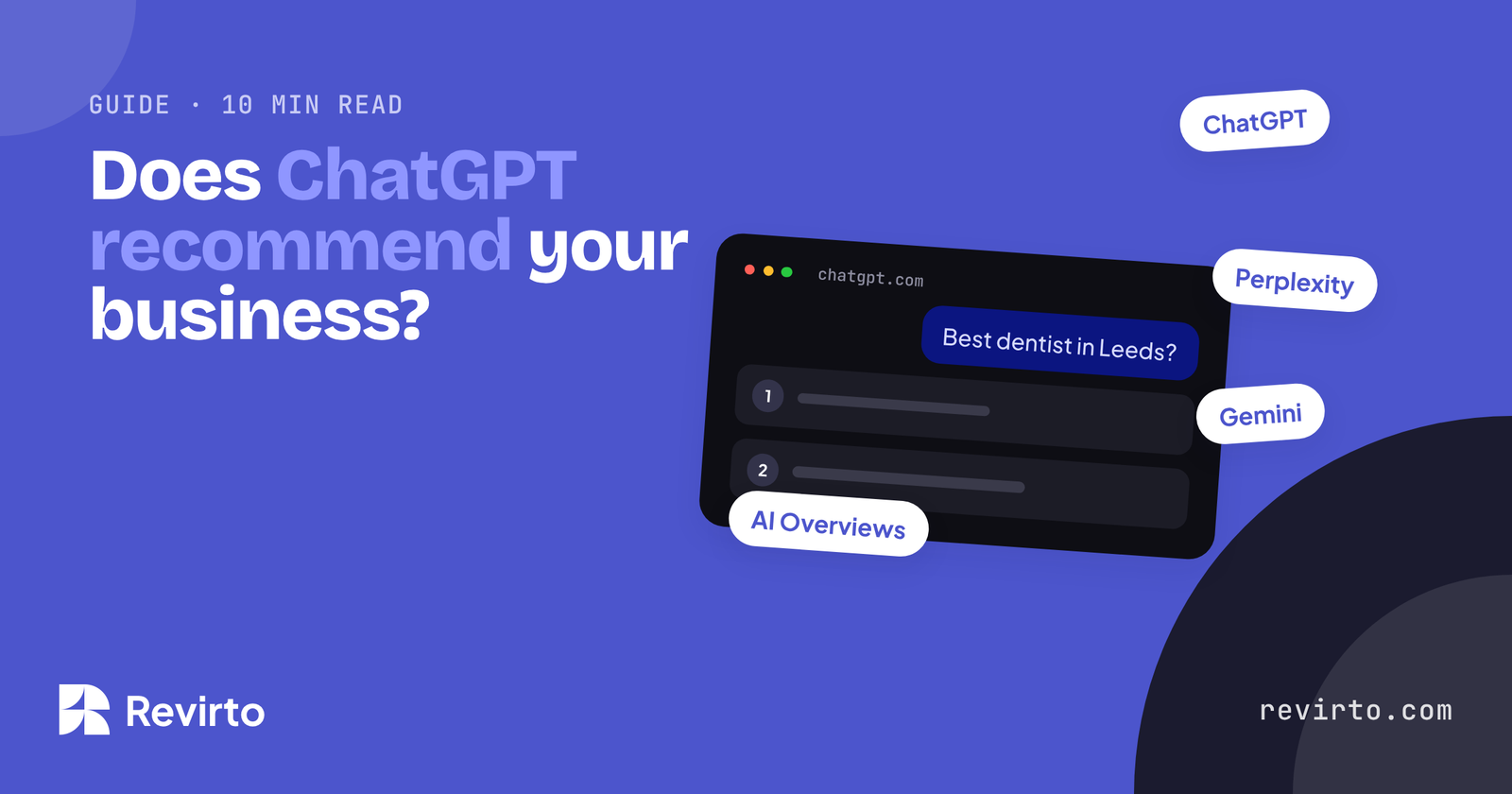
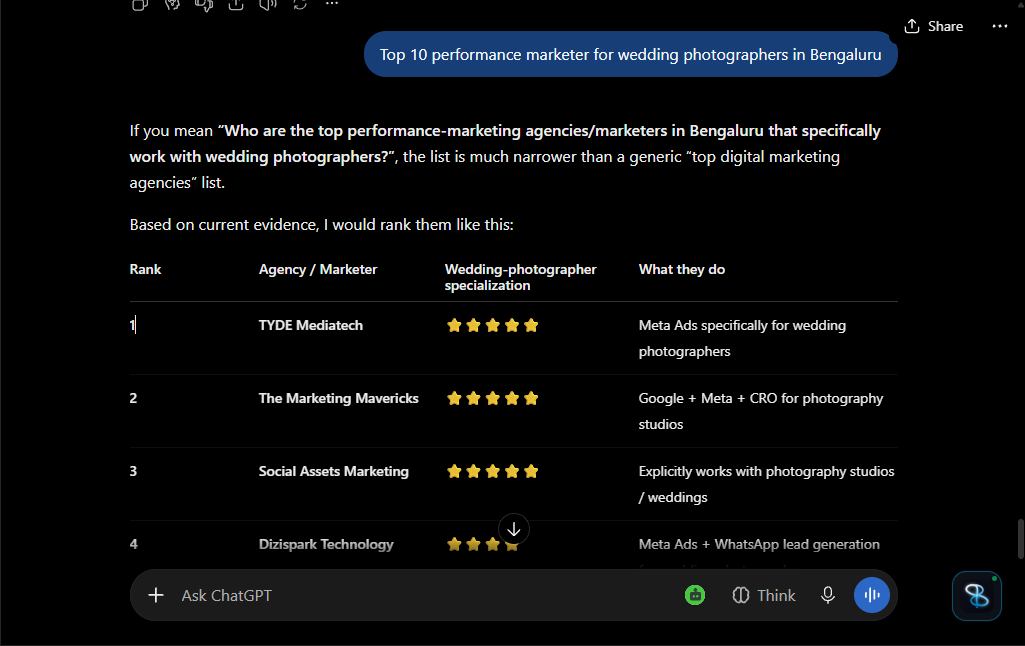
To check if ChatGPT recommends your business, write down 10 questions your buyers would ask, open a private browser window, log out, and ask each one in ChatGPT, Perplexity, Gemini and Google. Note who gets named and in what order. Repeat it every month with the exact same wording. One check is a snapshot; the trend over three months is what tells you where you stand.
Why does it matter if ChatGPT names you?
More buyers now ask an AI tool the question they’d ask a friend: “Who’s a good physio near me?” or “Which architect in Dubai does villa renovations?” The answer is short. Two or three names, a reason for each, and often no list of links at all.
If you’re one of those names, you get the call. If you aren’t, the buyer may never see your website. You can’t fix what you haven’t measured, so the first step is simply finding out where you stand today. Checking is free. Fixing it is the work of AI SEO.
Which questions should you test?
Use your buyers’ words, not your service names. Nobody types “bespoke interior design solutions”. They type “who can redesign my living room in Toronto?”
Write 10 questions across these four types:
| Type | Example | How many |
|---|---|---|
| Best in place | Who is the best family dentist in Leeds? | 3 |
| Specific need | Which accountant in Leeds works with contractors? | 3 |
| Price and value | How much does Invisalign cost in Leeds, and who’s good? | 2 |
| Comparison | Is [your business] or [competitor] better for implants? | 2 |
Where to find them: ask your last five clients what they typed or asked before they found you. Read the questions in your Google reviews and enquiry forms. Look at Google’s “People also ask” box for your main service.
How do you test without your own history changing the answer?
AI tools personalise. If you’ve talked to ChatGPT about your business before, it may mention you because it remembers you, not because it would recommend you to a stranger. These steps take the guesswork out:
1. Use a private window and log out
Open a private or incognito window. Don’t sign in to ChatGPT, Gemini or Perplexity. If a tool needs an account, use a fresh one that has never mentioned your business.
2. Set the location
Many answers depend on where the tool thinks you are. If you sell in Leeds but sit in Hyderabad, put the city in the question every time.
3. Use the exact same wording every month
Save your 10 questions in a document and paste them. Small wording changes give different answers, which makes month-to-month comparison useless.
4. Check four places
ChatGPT, Perplexity, Gemini and a normal Google search (for the AI Overview at the top). Each tool picks differently, so being named in one doesn’t mean you’re named in all.
5. Screenshot everything
Save a screenshot of every answer with the date. In three months, these are your before-and-after.
How do you read the results?
Put your results in a simple sheet: one row per question, one column per tool. For each cell, write where you appear.
| Result | What it means |
|---|---|
| Named first | The tool trusts you for this question. Protect it: keep content and reviews coming. |
| Named, but not first | You’re in the running. The businesses above you usually have more mentions on other sites. |
| Mentioned only when you ask about yourself | The tool knows you exist but doesn’t see you as an answer. Your pages probably don’t answer the buyer’s question clearly. |
| Not named at all | The tool can’t find enough about you, or can’t connect you to this question. Start with your service pages. |
| A competitor is named every time | Look at what they have that you don’t: a page for that service, reviews that mention it, a listing on the site the tool cites. |
Look at the sources too. Perplexity and AI Overviews show the pages they used. If the same directory or “best of” list keeps coming up, that’s a site you need to be on.
Don’t judge on one check. Answers move from week to week. In the Tyde case study, we tracked 26 questions every month and the trend, not any single answer, showed what was working.
Why do the four tools give different answers?
Don’t be surprised if ChatGPT names you and Gemini doesn’t. Each tool builds its answer differently:
| Tool | Where its answer comes from | What to look at |
|---|---|---|
| ChatGPT | Its own knowledge plus a live web search for many local and recent questions | Who’s named, and the sources under the answer when it searched |
| Perplexity | A live web search every time, with numbered sources | The sources: they show you exactly which sites it trusts |
| Gemini | Google’s index and Google Business Profiles | Whether your Google profile and reviews are doing their job |
| Google AI Overviews | Pages that already rank in Google for the search | Whether your page is one of the cited cards |
A business that’s strong on Google but invisible in ChatGPT usually has a good website and a good Google profile, but few mentions on other sites. The reverse is rarer. Being named across all four is the goal, and the gaps tell you where to work next.
Common mistakes
| Mistake | Why it gives you the wrong picture |
|---|---|
| Checking while logged in | The tool may name you because of your own past chats |
| Asking about yourself by name | “Is Revirto good?” tells you nothing about whether buyers find you |
| Using your own words | “Bespoke solutions” isn’t what buyers type, so the answer won’t match theirs |
| Changing the wording each month | You can’t compare months if the question changes |
| Judging on one check | Answers move week to week; three months of the same check shows the trend |
What if you’re not named?
Most businesses aren’t, at first. The fix is usually the same five things, set out in how to get your business recommended by ChatGPT: write down the buyer questions, give each one a clear page, get named on other sites, show up on LinkedIn or YouTube, and check every month.
Start with the questions where you’re “mentioned only when asked”. You’re closest on those.
Want the full picture? This self-check covers 10 questions. On a free call, we run your top three questions live, show you who AI names and what those businesses have that you don’t, and give you a plan with a fixed price. Book a free call.
Your first 30 days
- Write 10 buyer questionsin your customers’ words
- Run each one logged outin ChatGPT, Perplexity, Gemini and Google, and screenshot the answers
- Put the results in a sheetnamed first, named, mentioned only when asked, not named
- Pick your three closest questionsand fix the page that should answer each one
Common questions
How often should I check?
Once a month, on the same day, with the same wording. Weekly checks mostly show noise.
Why does ChatGPT give a different answer each time?
AI tools don’t return a fixed list. They write a fresh answer every time, so names can move. That’s why the monthly trend matters more than one answer.
Does it matter which version of ChatGPT I use?
Use the free, logged-out version for your check. It’s closest to what most of your buyers see.
Can I pay ChatGPT to recommend me?
No. Ads in AI tools are labelled as ads. The recommendation itself comes from what the tool has read about you.