
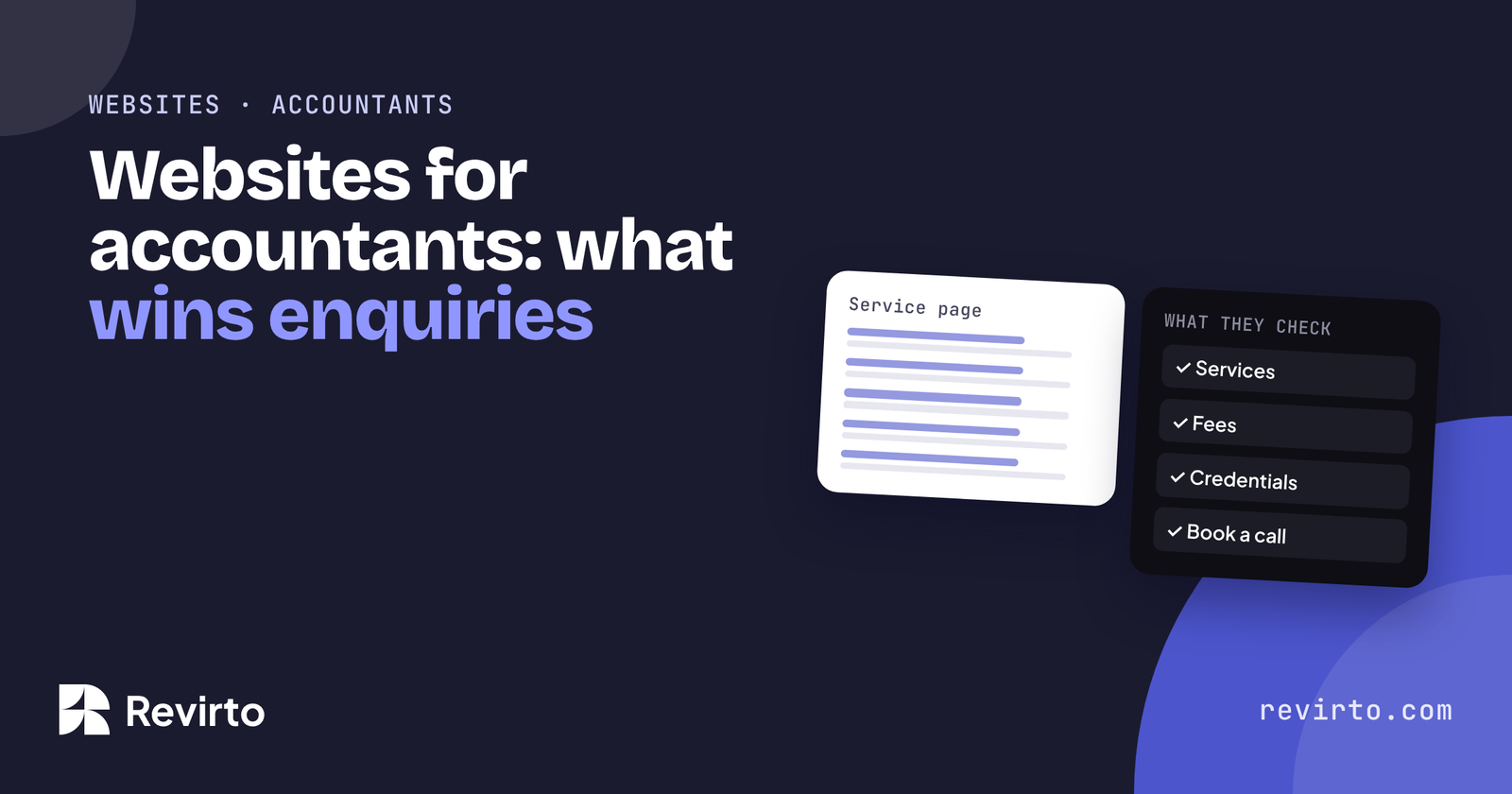
An accountant’s website wins enquiries when it answers five questions fast: what do you do, who for, what does it cost, can I trust you, and how do I book. That means a page per service, fee ranges or fixed fees, credentials and named accountants, reviews from similar clients, and a booking link on every page. Most firms lose enquiries on fees and booking.
What do people look for on an accountant’s website?
Choosing an accountant is a trust decision. A business owner is about to hand over their numbers, their tax and often their worries. They usually compare two or three firms, and the website is where most of that comparison happens.
This guide is written for UK and US firms, but the five checks are the same everywhere:
| What they check | The question in their head | What answers it |
|---|---|---|
| Services | Do you do what I need? | A page per service, in plain words |
| Fit | Do you work with businesses like mine? | Named industries and client sizes |
| Fees | Can I afford you? | Fixed fees, packages or “from” prices |
| Trust | Are you qualified, and are you good? | Credentials, named staff, reviews |
| Next step | How do I start? | A booking link or form on every page |
If any one is missing, they move on to the next firm in their tab.
Which pages does a firm need?
Keep it simple. Most accounting firms need eight to twelve pages:
Homepage
Who you help, where, and the next step, in the first two lines. “Accountants for contractors and small businesses in Leeds. Fixed monthly fees from £95.”
One page per service
Bookkeeping, year-end accounts, tax returns, VAT or sales tax, payroll, advisory. Each with what’s included, who it’s for, the fee and FAQs.
One page per client type
Contractors, landlords, e-commerce sellers, medical practices. Owners search for “accountant for landlords”, not “accountancy services”.
Fees or pricing
A table of packages, or “from” prices for each service. See below.
About and team
Named accountants with photos, qualifications (ACCA, ICAEW or CIMA in the UK; CPA in the US) and the sectors they know.
Reviews and case studies
Short stories: the client, the problem, what changed. “Moved a landlord’s 14 properties onto one system and cut their tax bill by planning ahead.”
Contact and booking
A calendar link, a phone number and an address with a map.
That’s the structure we use for websites for professional firms: one page per question a client asks.
Should you show your fees?
Yes, at least as ranges or “from” prices. Most owners won’t book a call to find out if they can afford you. A firm that shows “Sole trader accounts from £300 a year” gets the enquiry over the firm that says “contact us for a quote”.
| Fee approach | Works well for | Example |
|---|---|---|
| Fixed monthly packages | Bookkeeping and compliance clients | Starter £95/month, Growth £195/month |
| “From” prices per service | Firms with varied work | Self-assessment from £250 |
| Ranges with what moves the price | Advisory and complex work | £1,500–£4,000, depending on entities and turnover |
Then explain what pushes the price up: turnover, number of transactions, payroll size, or how tidy the books are. That honesty builds trust before the first call.
How do you turn visits into calls?
- A booking link on every page: not just the contact page. Calendly or a similar tool works fine.
- A short form: name, email, business type, turnover band, and what they need. Five fields, no more.
- A reply time on the page: “We reply within one working day.” Then keep to it.
- A clear first step: “Free 20-minute call. We’ll tell you what you need and what it costs.”
- Mobile first: many owners look you up on a phone between jobs. Test your form on one.
Before you launch any changes, run through our website launch checklist: test every form, check the speed on a phone, and make sure enquiries arrive.
What makes it AI-ready too?
More owners now ask ChatGPT “who’s a good accountant for contractors in Leeds?” The same pages that convert people also help AI tools name you. Here’s how to make your WordPress site AI-ready, but the short version for accountants is:
- One page per service and per client type, with the city on the page
- Fees on the page, so the AI can answer “how much”
- A complete Google Business Profile, and listings on your professional body’s directory
- Reviews that mention the service and client type: “they sorted my VAT as a contractor”
- Schema for your firm (AccountingService), your services and your FAQs
Common questions
How much does a website for an accounting firm cost?
For a firm site of 7 to 12 pages, expect $1,000 to $5,000 with an agency. Here’s a full breakdown of what a WordPress website costs.
Should every accountant have a profile page?
Yes. People choose a person as much as a firm. A page per accountant, with qualifications and sectors, helps clients and AI tools.
Is a blog worth it for an accounting firm?
Yes, if it answers real client questions, like tax deadlines or what changes this year. One useful post a month beats ten generic ones.
Can I use a template website?
You can, but most templates hide fees, use one services page and load slowly. Those are the three things that cost enquiries.